Marin Sun Farms has purchased Petaluma’s beleaguered Rancho Feeding Corp.
If you’ve ever taken a drive to Point Reyes National Seashore and found yourself on a lonely, foggy road with only cows for company, you may have visited Marin Sun Farms without even knowing it. Though it made national headlines this spring as the company taking the reins at the shuttered Rancho Feeding Corporation in Petaluma, Marin Sun Farms has been a part of Northern California’s landscape and meat-producing community for many years.
Whether you’re just hearing about it for the first time or have long been a loyal customer, you may be surprised at just how deep its roots in our local food system stretch and how its purchase of the slaughterhouse fits seamlessly into its vision of a fully integrated and sustainable food model in the Bay Area.
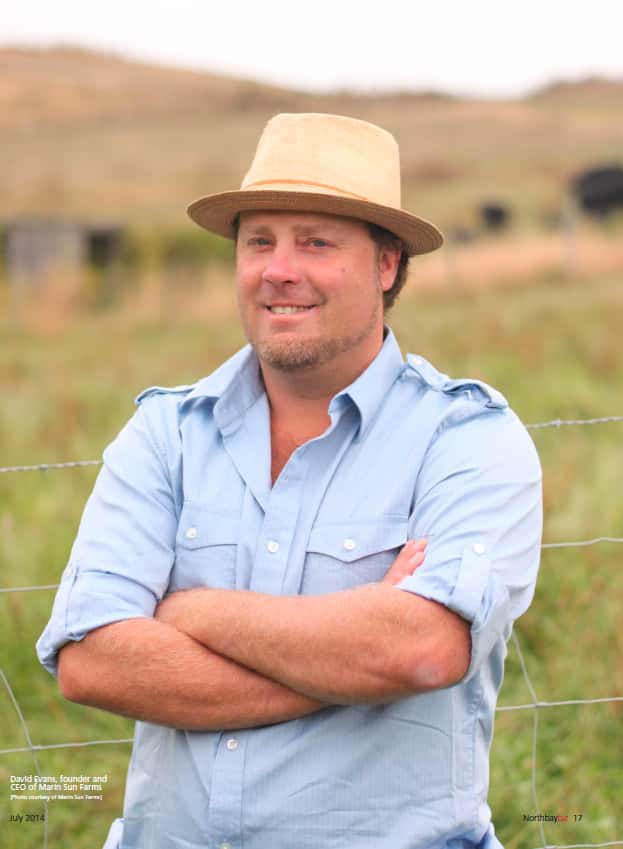

David Evans, founder and CEO of Marin Sun Farms (MSF), is a fourth-generation Northern California rancher. He currently oversees two ranch leases in western Marin, focusing on beef, poultry and egg production.
When Evans first returned to the family business, fresh out of college in 1996, he was determined to bring a new breed of agricultural and business methods to the local ranching industry. Now in his early forties, he’s become a spokesman for the “pasture to fork” movement, working to create the smaller-scale connections and infrastructure that will let family farmers and ranchers make environmentally responsible decisions and still earn a living. [Evans was asked to participate in this article but was unable to due to time constraints.]
He started MSF in 1999 and began to sell not only products from his own ranches, but also from a group of other local producers, starting with his own friends and neighbors. Known as “co-producers,” these ranchers’ products help MSF keep up its seasonal inventory, offer customers more variety and share certain resources. In turn, MSF can create longer-term contracts with these providers and get their products to market, which helps them plan for the future.
Evans sells everything under the MSF label, a move that’s meant to act as an indication to consumers about the strict standards under which the animals were raised. The labels are color-coded to advertise whether the animal was 100 percent grass-fed or pasture raised, and additional labels bear the name of the co-producer and county of origin.
According to MSF, all of its products are grown without synthetic hormones or antibiotics, using “low stress” handling methods, and on family farms that practice certain regenerative land management techniques, such as composting and herd rotation to prevent overgrazing.
Getting to market
One major challenge for small-scale ranchers is distribution, or simply getting their products to consumers, and MSF is no exception. For Evans and his staff, weekends mean farmers markets, with booths at the San Francisco Ferry Plaza Farmers Market on Saturdays and the San Rafael Farmers Market at the Civic Center on Sundays.
Brigitte Moran is CEO and executive director of the Agricultural Institute of Marin (AIM), which manages seven farmers markets in the Bay Area, including the one at the Civic Center. AIM also works to educate local consumers on the economic and health benefits of buying locally sourced food straight from growers.
Moran has seen the number of meat and dairy producers selling at the market rise in the last 10 years, in large part thanks to the trailblazing efforts of Evans and Doug Stonebreaker, founder of San Francisco-based Prather Ranch Meat Company.
“David [Evans] was one of our first Marin-based meat ranchers to come into the marketplace, so he’s led the way for Marin ranchers going from the commodities market into the direct market,” says Moran.
She notes that though, technically, Evans and Stonebreaker are competitors in the market, they’re also friends who often work together on how to move the industry forward. “Doug can tell David, ‘Hey, I’ve already done that and it didn’t work,’ and David’s done the same for a lot of the other Marin ranchers, as well,” explains Moran.
The Center for Urban Education about Sustainable Agriculture (CUESA) of San Francisco manages the farmers market at the San Francisco Ferry Plaza, where MSF has had a presence for a decade. As part of its educational outreach, CUESA sends out weekly newsletters, puts on youth programming and works closely with local chefs, both to make it as easy as possible for them to shop at the market and on creating recipes to encourage visitors to try new products and varietals.
“This is one way we can help make farming more economically viable—by offering the education that gets people to demand good, fresh local produce and meats and to work with chefs, who are placing a lot of orders each week,” says Susan Coss, CUESA’s director of marketing and public relations.
CUESA also runs a popular farm tours program six to seven times per year, where groups visit two Northern California food producers for a first-hand look into what goes into growing or making the foods they see at the weekly markets. In 2013, visitors toured an MSF ranch, with past tour destinations including Cowgirl Creamery in Petaluma, Green Gulch Farms in Muir Beach and Eatwell Farm in Dixon.
“Any time we can put a face to something, it creates more of a personal relationship between the farmers and the consumers,” says Coss.
Expanding reach
In addition to farmers markets, MSF has developed other ways to get its products to consumers. Most traditionally, it supplies meats directly to dozens of smaller butcher shops and groceries in the Bay Area and Los Angeles. It also operates an online butcher shop, where customers can order frozen cuts of meat to be delivered to their doors.
Borrowing from an idea growing in popularity among local produce farmers, MSF also operates a meat CSA. The CSA (short for community-supported agriculture) is a membership program, ranging from six to 12 months, in which members receive a monthly variety of frozen meats, often at a savings of up to 20 percent off original prices.
Boxes contain a mix of animals, such as beef, pork, chicken or lamb, at a variety of price points. Customers can choose to add fresh eggs, specialty holiday items and even MSF’s own wet dog food. Pick-up is available at dozens of locations throughout the Bay Area, including the farmers market locations.
In 2005, MSF made the jump to a brick and mortar location and opened the Point Reyes Butcher Shop and Restaurant on Highway 1 in Point Reyes Station. Here, visitors can shop from a wide selection of MSF meats or pick up homemade stocks and side dishes. The restaurant, with seating inside or at picnic tables outside, features a menu of steaks, salads, sandwiches and goat, lamb or beef burgers, all made with locally sourced produce and meats from MSF’s circle of co-producers.
In 2010, MSF expanded again, this time opening a permanent butcher shop inside Rockridge Market Hall in Oakland, a European-style, one-stop marketplace containing businesses like a fishmonger, bakery and produce stand. MSF’s shop contains a 140-foot-long butcher case, offering shoppers the variety of meat products and eggs that MSF now delivers.
MSF had been cutting and packing its products in leased space at a plant in San Francisco. But in 2013, it moved into its own 18,000-square-foot facility on Bryant Street. At the federally inspected facility, animal carcasses are aged, cut and packaged for distribution to MSF’s butcher shops, CSA members and for wholesale buyers in Northern and Southern California.
Closing the gap
By the end of 2013, MSF was actively involved in the management of nearly every step of meat production: raising the animals, cutting and packaging, sales and distribution. It was even grilling it up for us with a side of fries cooked in pork lard. But, like nearly all small-scale ranchers in the North Bay, it still relied on an outside slaughterhouse to complete the cycle. For many years, Rancho Feeding Corporation in Petaluma was the only practical option for local, small-scale ranchers, with the next closest federally inspected plants located in Eureka or the Central Valley—several hours away by truck.
When the U.S. Department of Agriculture closed Rancho in early February after a massive beef recall, many area ranchers were left in dire straights, not only faced with losses from the recall but also with nowhere to bring their current herds to be slaughtered.
After assembling a group of investors, MSF closed on a deal to purchase the Rancho plant on February 28 and was given the go-ahead to re-open the facility April 7. In a statement announcing the purchase, Evans said that the slaughterhouse, “is the access to market we all desperately need to continue together in transforming the food system.”
MSF plans to link operations between its Petaluma and San Francisco facilities and make them available to all its customers, so meats can be cut and wrapped to specification and delivered to customers’ accounts in the Bay Area or Los Angeles area, all by MSF personnel.
Tim Tesconi, executive director of the Sonoma County Farm Bureau, says that the plant’s closing represented a huge loss for area ranchers and that he sees MSF’s purchase as a positive development. “This is very important for the economics of Sonoma County agriculture,” he says. “We have the land, the people and the will to produce great, sustainably grown food, whether it’s meat, dairy or produce. But it takes infrastructure, and a federally inspected slaughterhouse is part of that infrastructure.”
Looking ahead
The MSF-Petaluma plant opened as planned on April 7 and is already handling beef and pork, with plans to add goat and lamb in the future. Evans also announced plans to have the Petaluma and San Francisco plants certified as organic by the end of 2014 to meet the demands of the region’s organic ranchers.
This summer, Evans and MSF will be honored as the Sonoma County Fair’s 2014 Rancher of the Year for his years of contributions to the local meat-producing community. Evans himself has described his goal in the last 15 years as to create an “integrated livestock production network,” and with MSF’s purchase of the Petaluma facility, that goal appears to be coming full circle.
“I can’t emphasize this enough, how [the slaughterhouse] is a linchpin of the whole agricultural movement toward locally produced meats,” says Tesconi. “We’re so grateful to David for pushing forward to resurrect Rancho as part of the vital infrastructure for North Bay ranchers.”
Victorian Farmstead Meat Company
By M.V. Wood

“My customers have to know they can trust me, because I’m providing them with the food they put in their bodies,” says Parks, owner of Victorian Farmstead Meat Company. The business, which specializes in hyper-local, all-natural and pasture-raised beef, lamb, chicken and pork, is one of several local suppliers that will be using the new Marin Sun Farms facility in Petaluma.
So, how does he go about earning their trust?
“I earn their trust through diligent transparency,” he says. “My customers know if I tell them how our meat is fed or cared for, I can back it up by actually showing them: I’m honest.”
Now, there’s being honest in the “don’t lie” version of the word. And there’s also being honest in the “tell the truth, the whole truth, no-holds-barred, no filters” version of the word. Parks practices the latter.
For example, when asked how he became involved with producing high-quality meats, Parks talks about the health of people and the planet, mentions his children and future generations, says something about sustainability and eating local. But all of that comes after he first blurts out: “After we lost everything and moved onto my grandfather’s farm, I had to feed my family. So I bought a couple of piglets and some chickens and raised them for food,” and one thing led to another.
There was a time when Parks was much more smooth and polished than he is now. He grew up on an 800-acre sheep farm in Tomales but, once he turned 17, he left the fields and small town went to college, eventually entering the business world; first in insurance and then as a tour coordinator for the Canadian PGA Tour.It was an elite, image-conscious field he lived in, and Parks excelled. He rubbed shoulders and hobnobbed; he did lunches and tee times. And, although he didn’t lie as a sales and marketing executive, there were times when some “omissions” were made and some positive spins were constructed.
There was a little voice inside him that pleaded for a more organic lifestyle. But it was hard to hear that voice over the roar of success, as Parks accumulated a house and cars and pretty knick-knacks. But then, as the housing bubble burst and the economic crisis hit, Parks’ well-constructed world fell apart. He had to return to Sonoma County with his wife and children and move to the family-owned Victorian Christmas Tree Farm.
“That was a huge life lesson, which I now appreciate. It forced me to return to my roots and look at all the mistakes I’d made,” Parks says with what sounds like a sigh of relief. He soon found that a homecoming can often be accompanied with a return to a more down-to-earth, grounded way of being.
He started raising the piglets and the chicken for his family and raised a few more to butcher and take to the farmers market. “When I opened the butcher shop in Community Market [in Sebastopol’s The Barlow] last November, I couldn’t afford to hire a real butcher, so I learned how to do it myself out of necessity. A couple of amazing professional butchers took me under their wing, and I’ve developed a huge respect and a passion for it as an art form,” says Parks.
With his success at the farmers markets, Parks expanded his business by starting a CSA subscription box for meats. Soon enough, he reached the limits of how much livestock he could raise on the farm, especially since all of his animals roam about freely and use a lot of room. So Parks contacted some childhood pals, friends and neighbors who are ranchers, and enlisted their help in supplying him with more meat. “I know these guys. I know how they take care of their animals and I know they have the same high standards as I do. I trust them,” Parks says.
“For my friends, their passion is to be ranchers. For me, my passion is still in marketing and sales. So we make a good team. And as far as my approach to marketing and sales goes, it’s all about providing information and help. For example, if someone says they can’t afford my product, I don’t try and talk them into it, make them feel less than or guilty for supporting unsustainable agriculture. What I will do is ask them what their budget is and how many people they need to feed. And then I’ll show them how to spend $15 on a couple of lamb necks and make some amazingly delicious lamb carnitas to feed four. It’s about giving full and accurate information and building relationships. It’s a great way to do business because it works. My customers come back. It’s also a great way to do life.”