Fun Bike Unicorn Club has come together to celebrate the humble bicycle in unexpected and delightful ways.

Making it happen
There’s certainly no single date when friends in these parts started getting together to build out custom bikes, hatch plans and talk shop. Sonoma County has long had an active and vocal cycling scene, but the number of people interested in bringing their mechanical skills to bear in creating one-off, sometimes fantastical vehicles was perhaps never in full display until the Great Handcar Regatta was born in 2008.
Founded by Spring Maxfield and Ty Jones, the Regatta was a one-of-a-kind community festival that brought people from all over the Bay Area and beyond to Santa Rosa’s Railroad Square. It featured art, live music and food, along with incredible people watching and elaborately decorated or redesigned railroad handcars to delight those lined up along the old tracks to watch the races.
While many local artists and bike crews were already doing their thing at events around the bay, the Regatta suddenly gave some a very high-profile outlet for displaying their workmanship. The groups weren’t all about one sensibility or lifestyle, but often brought the same sense of adventure and play to their experiments in mechanics and showmanship.
At the time, groups were autonomous and people needed to track them down separately. As more requests for appearances came in to the individual creators from community festivals looking for new and unusual attractions, the idea began brewing that having one central organizing group might be helpful to everyone.
Todd Barricklow of Santa Rosa was one of the artists at the center of this pedal-powered revival, along with his wife (and Regatta co-founder), Maxfield. His old-fashioned and oversized bicycle creation, nicknamed “The Two Penny,” had become one of the iconic images of the festival.
Originally from Southern California, Barricklow graduated from Sonoma State University in 1992 with a major in ceramics. He used his graduation money to buy a welding kit and soon began working in earnest with metal, often making pieces that blended metal and ceramics. He’s now prototyping and producing public artworks for another local artist and making his own art from his backyard studios, one for metalworking and one for his ceramics and woodblock printing.
It was in Barricklow’s backyard that the first group of friends gathered to talk about forming this umbrella organization. When it came to naming the group, all options were on the table.
“We all tried to come with a few names in our pockets and, several beers later, all these guys had come up with Fun Bike Unicorn Club,” he recalls.
The name is occasionally hard for people to say with a straight face, which is half the fun. Members sometimes wear their matching pink Fun Bike Unicorn Club (FBUC) T-shirts to events, emblazoned with a toothy unicorn, and even started making motorcycle gang jackets with the name stitched on proudly.
“One thing I can say for sure is that my daughters were more interested in coming out to events after seeing that name,” laughs Barricklow.
Building a community
Membership in FBUC has never been a one-size-fits-all proposition. On its website, FBUC describes itself as “a loose collective of whimsical builders, inventors, artists and rabble-rousers who happen to love bikes and unicorns.” Some have come to the group because they’re part of an arts collective or smaller bike club with friends, but appreciate the larger sense of camaraderie and event opportunities the club provides. Others might come out to race a beloved pedal car or ride a home-built bike in a parade. Others just get a kick out of seeing what’s up on the group’s Facebook, Tumblr and Flickr pages, or on FBUC’s YouTube channel.
“People are in all these different clubs, but everybody’s in FBUC,” explains Barricklow. “We’ll all meet up when there’s an event and we need to get the exhibits ready. The lines are really blurry.”
Affiliated bike crews often have names as tongue in cheek as FBUC’s. Krank-Boom-Clank is an industrial arts collective in Santa Rosa and one of the early FBUC members. Founded by local artists David Farish and Skye Barnett, they specialize in “kinetic conveyances of whimsy”: one-of-a-kind, pedal-powered art pieces. Among their works, “Hennepin Crawler,” which is equal parts refined lady’s carriage and oversized Lego car, has been available to rent by the hour for weddings, corporate events and festivals. Bunnyfluffer Cycles, the brainchild of steel artist Arn Anderson, presents bicycles that play with juxtapositions of size, proportion and materials to bring a fine art sensibility to utilitarian transport.
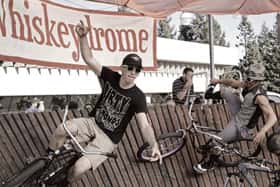
Another group under the FBUC umbrella is Whiskeydrunk Cycles (WDC), a group of 10 to 15 friends who get together frequently in each other’s garages and workshops. Members are metal fabricators, professional welders, teachers, artists and occasionally daredevils.
Dimitri Gortinsky of Santa Rosa is a third grade teacher, underground DJ and member of the WDC crew, often manning the sound system for WDC and FBUC events. He joined FBUC just a few months after it was started because he thought it made sense to have a group that could be accepting to all those interested, in a way that smaller groups simply couldn’t. Gortinsky admits it’s hard to put down on paper just what WDC and FBUC are, but knows they’ve taken on lives of their own.
“They’re kind of more like art groups, though that’s not what our intention is,” he says. “We don’t say we’re a bunch of artists and we have to do this. We just have cool friends and fun ideas we want to pull off, so we meet to make sure we can.”
Assembling an audience
FBUC has been invited to participate in everything from parades to revivals, sporting events to neighborhood parties. In the past, vehicles have shown up at Santa Rosa’s Harmony Festival and Levi’s GranFondo, the Gravenstein Apple Fair in Sebastopol and parades as far away as Santa Cruz. They fit right in at Petaluma’s eclectic Rivertown Revival in July and Santa Rosa’s Sonoma County Bicycle Expo in August.
At Pedal Fest, held in July at Jack London Square in Oakland, WDC again entertained the crowd while raising money for Bike East Bay, which helps create safe, local biking opportunities. FBUC will also be represented at Winterblast, an annual open studio art party held in Santa Rosa’s South of A Street (SOFA) District in November.
As to what FBUC members are bringing to these community events, the answer is as individual as the members themselves, but it usually involves wheels and whimsy. WDC members have completed several ideas for display, including an old-timey dunk tank made from a reused redwood barrel, which has had to be retired during the drought.
Their most popular attraction is the Whiskeydrome, a handmade velodrome, or banked wooden bike track of sorts, five feet high and 30 feet in diameter on top and narrower at the base. It’s based on a 1902 track called “Keith’s Bicycle Board Track” that members decided to recreate for the heck of it. It’s been labeled everything from a kinetic art installation to a carnival attraction, but once the Whiskeydrome’s set up, it’s not long before someone starts up some music, a few bikes get tossed in, and a crowd gathers to see what will happen.
“We’ve had up to eight or nine people at a time in there: criss-crossing, riding in opposite directions, two people going criss-cross in opposite directions,” says Gortinsky. “It’s pretty wild.”
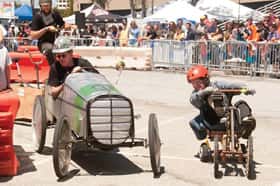
FBUC has also been participating in area Maker Faires for the last five or six years [see “The Maker Movement,” below]. For the last three years, this has included putting on the Death-Defying Figure 8 Pedal Car Races.
“We raced every hour on the hour for two days straight last year,” says Barricklow. “It was lots of crashes and camaraderie and playful antagonism. Between races, we’re in the pit taking apart these cars we’ve just broken and trying to fix them right then and there, so there’s lots of time for people to talk to us and look at them.”
One thing you might notice is that many of these events are fund-raisers or free to the public, which means budgets are generally slim. Barricklow says that some events offer compensation, but it generally goes to covering costs, which include trucks and trailers to carry the vehicles, truck and liability insurance and fuel.
“Payment is always great but doesn’t always happen, and isn’t what we’re in this for,” he says. “The main reason we do this is fun. No one’s quitting their day jobs and walking away with pockets full of cash.”
The payoff
As loosely defined as their mission is, FBUC seems to have three main goals: to make things they love, to encourage others to make things they love and to have a good time with people they like.
“The club kind of ebbs and flows as people’s lives change, but it’s a nice thing to be a part of something where the goal is to have fun,” says Barricklow. “We’d just really like people to turn the TV off and go out in the garage, break something and then make something.”
Gortinsky agrees that no one’s getting rich off these passion projects—and that suits him just fine.
“We try to make it an endeavor that fulfills us enough to make us want to go back even without getting paid to do it,” he says. “If we’re not having a good time, then why are we doing it?”
The Maker Movement

In 2005, Dale Dougherty, a co-founder of O’Reilly Media in Sebastopol, started Maker Media as an arm of O’Reilly Media and began publishing Make magazine. (Maker Media was spun out as a separate company in 2013.) The magazine, now with roughly 300,000 readers, brings together ideas, inspiration and interviews with creative types from a variety of industries. The company also markets a line of “getting started” technology kits, books and DIY supplies, which it sells in its Maker Shed online store (www.makershed.com).
In 2006, Maker Media organized its first ever Maker Faire in San Mateo. Billed as “The Greatest Show and Tell on Earth,” Maker Faire was meant to be a meeting place for creative builders, thinkers and experimenters from all over.
Since then, it’s not only blossomed, but multiplied. The 9th Annual Maker Faire Bay Area took place in May, with more than 130,000 attendees and 1,100 maker entries at the two-day event. The 5th Annual World Maker Faire, held at the New York Hall of Science in September, was expected to welcome more than 85,000 attendees and at least 750 makers. In June, President Obama welcomed a smaller group of young makers to Washington, D.C., for the first White House Maker Faire. Other Maker Faires were also held in several cities in Europe and Asia.
Of course, not everybody can attend one of these larger events, which has led to the creation of independently produced Mini Maker Faires. In 2013, more than 100 such community events were staged, including ones in Santa Rosa (Wells Fargo Center for the Arts), Greenbrae (Bon Air Center), Willits (Mendocino County Museum) and a Sonoma County Maker Kids Faire (Sonoma Country Day School).
Visitors to both Maker Faires and Mini Maker Faires come to share what they’ve built and to see what others have built. They leave with new skills, new enthusiasm and new ideas about what it’s possible to accomplish. Most important, it’s estimated that 50 percent of adult visitors have brought children along for a day of hands-on learning, leading many to hope that the “Maker Movement” is just beginning.
Biking on Water
“I thought, ‘Wouldn’t it be cool to bike down to the water’s edge and into the city from the East Bay?’” he remembers. “I became obsessed with this idea of biking across the water.”
Instead of letting it go, Schiller began researching online and found that people around the world have been dreaming of the same thing for decades, with patents for water bike contraptions reaching back 100 years. He began testing out ideas, using a 20-year-old Italian flotation system he ordered from Europe and a traditional bike frame as his original prototype. In September 2013, he completed a bike ride across the bay on that original device, with another ride across the Hudson River a week later, and the media attention he received was overwhelming.
“People reached out from all over the world, wanting to buy one or partner with me or just learn more about them,” says Schiller. “That’s when I decided to design and manufacture the world’s most advanced water bike.”
Once he knew water biking was possible, he went back to the drawing board to design a better product. That included scrapping any idea of mounting a bike onto something, as traditional road and mountain bikes just aren’t built for the water.
“No one’s ever said, ‘How do we combine an iconic design language, the best technology and engineering, and all the brand marketing pieces that go along with it to create a consumer product that will make water biking safe, exhilarating and fun?” says Schiller. “That’s what we’ve set out to do.”
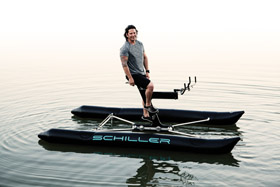
In August, Schiller officially launched Schiller Sports, Inc. (www.schillerbikes.com), which sells the water bikes directly to consumers. The Schiller Bike’s aluminum frame now sits on streamlined, inflatable pontoons and is connected to a proprietary carbon belt drive system. The rudder was replaced by a set of oscillating propellers controlled by the bike’s handlebars.
The company’s first product, the X1, retails for $6,495 and can be purchased in several different color combinations. A limited release Founder’s Edition bike sells for $8,775 with a series of special features and a technology guarantee, so if the company innovates something that improves speed or performance in the next two years, the bikes will automatically be upgraded for free.
The Schiller Bike is designed so that most of it can be disassembled into a single duffel bag, including the inflatable pontoons. Its 32-inch frame can be mounted onto a car’s rear bike rack or, with an adaptor, onto a rooftop rack.
Schiller believes his invention can be used by a wide range of people, whether athletes looking for a challenging and varied workout on the choppy bay waters or friends taking a leisurely ride on Lake Tahoe. He’s already in talks with hotels and resorts interested in having the water bikes on their beaches.
Schiller shared that his company’s longer-term vision also involves manufacturing a specialized line of bikes that can be used in the developing world, where water-based communities in places like Southeast Asia might benefit from safer, environmentally sound methods of transportation.