

 Brrrr!
It’s cold, it’s funny—and it’s increasingly celebrity-driven. More important, it’s lucrative.
The ALS Ice Bucket Challenge reached a viral tipping point this summer, with close to $22.9 million raised between July 29 and August 19. Compare that number to $1.9 million, which is how much The ALS Association (www.alsa.org) raised from donors during the same period last year. (ALS, also known as “Lou Gehrig’s disease,” is a progressive neurodegenerative disease that affects nerve cells in the brain and the spinal cord. There is no known cure.)
The premise is simple. It involves people getting doused with buckets of ice water on video, posting that video to social media, then nominating others to do the same within 24 hours. Those who refuse to take the challenge are asked to make a donation to the charity. The commonly suggested donation is $100.
So initially, the assumption could be made that those being soaked had not made a donation. Of course, now that the challenge has become an international sensation involving countless celebrities, professional athletes and business and political leaders, it’s probably safe to assume many of those getting dowsed are also making contributions.
The challenge was started earlier this year by professional golfers as a way to raise funds for various nonprofits and causes (dumpees chose their recipient). It first got widespread media attention when golfer Greg Norman challenged “Today” host Matt Lauer, and he accepted on live TV; Laurer encouraged donations to the Hospice of Palm Beach County. That same day, golfer Chris Kennedy did the stunt and challenged his cousin, Jeanette Senerchia, whose husband, Anthony, has battled ALS for 11 years. It quickly became associated with ALS almost exclusively.
There’s no telling how long the fad will continue—or whether it will, at some point, revert to a more broad-based fund-raising campaign. So chill out and let the money flow.
 It’s About Time
Show of hands: Who’s busy?
That’s what we thought.
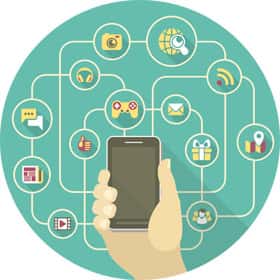
Increasingly, consumers are seeking ways to interact with the world when, where and how they need to. This has led to a rise in apps like Uber, Airbnb and GrubHub, which let users schedule services and make purchases with minimal clicks and no phone calls. Dubbed “the appconomy,” this growing trend is now manifesting in even newer apps, like MyTime, which can be used to book services as varied as haircuts, massages and oil changes (to name just a few).
Looking forward, MyTime creator Ethan Anderson sees an evolution toward “contextual awareness,” meaning instead of booking an appointment when you happen to think of it, future apps will be smart enough to know what you need (you’re overdue for an oil change or dental cleaning) and when you should go (you’re driving nearby and the provider just had a cancellation).
Now that’s instant gratification.
Touch of a Button
Oh no, did I turn off the heater at work before I left? Have my kids made it home from school yet? Did I remember to leave the porch light on for when I get home after dark?
In today’s hectic world, it’s no shock that more and more people are turning to automated control systems to ease their multitasking load—and, at the same time, their minds. The systems, which can be controlled from virtually anywhere via smartphone, tablet, computer or even a wall switch, are also an affordable way to save energy. You can use them to integrate electronic devices, audio and video systems, lighting, business and home security, irrigation control, HVAC and more. Wineries can use them for monitoring production, tank levels, fermentation temperatures, storage and beyond. There’s something out there for everyone’s needs.
“Control systems are perfect for vacation homes and businesses, even when they’re vacant,” says Jason Meyers, design engineer at Santa Rosa-based Summit Technology Group, which has many North Bay clients that use the systems. “They offer monitoring and remote capability and can provide text and email message alerts when systems go offline, entry is made to the premises and so forth. It’s an exciting concept that’s gaining popularity. They also offer increased security and minimal risk of hacking.”
Some of the products Summit recommends include Control4 (www.control4.com), Savant (www.savantsystems.com; a Mac-based platform), and Creston (www.creston.com), which is expandable to be used in high-end applications, large estates and commercial applications.
The end result: peace of mind.