Well, Well, Well
Sonoma County has more than 50,000 operating wells, serving more than 25 percent of the population. A recent survey shows that a majority of Sonoma County private well owners are concerned about their water levels.


The website covers a lot of ground with basic information about groundwater and wells, including maintenance, regulations and troubleshooting common problems. Separate sections are established for community discussions, product reviews and service provider references.
From the website: “Ruralwaterresources.com is a privately held, privately funded business built on the fact that managing well water is becoming increasingly vital to our shared future. We created our company to benefit property owners by providing a ‘central water management reference source’ that adds to those currently offered by public and non-government organizations.”
Sonoma County has served a testing ground for a statewide rollout in the coming months, then the website will go nationwide.
Green Energy Trends
According to Mother Earth News, here are three consumer-driven green energy trends that will have a direct impact on our pocketbooks in 2015:
Net-Zero Homes. Homebuyers are now emphasizing a home’s energy efficiency when looking for their next purchase. In response, homebuilders are focusing on “net-zero” buildings, which consume only as much energy as can be produced on site. If additional energy can be created and returned to the grid, that’s even better. To help meet this goal, active controls on solar panels and skylights are gaining attention, as is coupling active energy efficiency with traditional passive methods such as superior insulation, keeping a home airtight and double-paned windows.
Low- or No-Emission Cars. Fuel economy consistently ranks as the most important purchase factor for new car buyers. As a result, hybrids have shown steady linear growth, and sales for all-electric vehicles are increasing exponentially (and almost equal total sales for hybrids). Still, in the United States, green cars account for less than 1 percent of all vehicles on the road, so there’s a lot of room for increased market share.
Large-Scale Green Energy Production. Most people think about solar energy when they think “green,” but the total contribution from solar power to electrical demand in the United States is projected to remain close to 0.5 percent. Still, the U.S. Energy Information Administration projects that large-scale green energy sources will increase dramatically in 2015. In particular, wind power will increase more than 16 percent and contribute nearly 5 percent of our total electricity generation.The United States also remains the world’s leading geothermal market and exports nearly 30 percent of all geothermal energy around the globe. What’s more, with a focus on carbon emissions, the Energy Information Administration estimates an upcoming decrease in U.S. carbon dioxide emissions in 2015, with a marked drop in coal-based emissions.
Read more here.

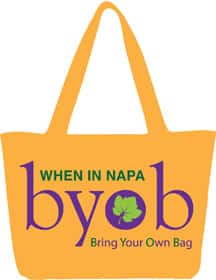
Bring Your Own
As of January 1, the city of Napa has joined the ranks of municipalities that’s adopted the Single-Use Carryout Bag Reduction Ordinance. Retail stores in the city will no longer provide single-use carryout plastic bags and must charge a minimum of $0.10 for each paper bag sold to customers. Customers have the option to bring their own reusable bags or to purchase paper or reusable bags from stores. Napa joins the growing list of North Bay cities to institute such a ban, including Santa Rosa, San Rafael, Novato and Sausalito.