A mash-up of glamorous and camping, glamping is the new alternative to sleeping on the ground or hitting the highway in a rented RV.

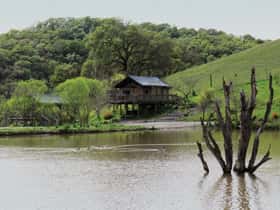
Fighting with the poles and stakes of a tent and lugging along a lot of special gear no longer appeals to many of us. Been there, done that. Face it––we can afford to upgrade and, frankly, we deserve more pampering.
Time to go “glamping.” A mash-up of glamorous and camping, glamping is the new alternative to sleeping on the ground or hitting the highway in a rented recreational vehicle (such as the unwieldy “RV” from the movie of the same name, starring the late Robin Williams).
Glamping is so chic that even household names at this year’s Academy Awards ceremony (but only those in the top categories—the Meryl Streeps and Benedict Cumberbatches) received an invitation in their swag bags for a complimentary glamping getaway. Among their options was a Northern California sojourn offering luxurious canvas tent accommodations on a private ranch. Add in a biking excursion along the Sonoma Coast and wine tasting in Napa Valley, and these A-listers could decompress in style after an exhausting movie awards season.
For the rest of us, glamping takes several forms in the North Bay: You’ll likely sleep on a raised platform and the mattress might be top-of-the-line. You may have an unobstructed ocean view, with waves crashing nearby. Your nights could be filled with stars, followed in the morning by a continental breakfast. The sounds of nature are all around you. Wi-fi access and cell phone service might be iffy or missing entirely, giving your tech-rattled nerves a rest.
Sound good? You’re ready to glamp.
Connecting to nature

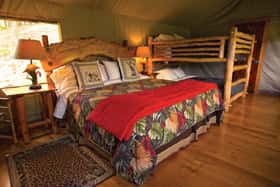
“I explain that our tents are like a hotel room, but with canvas walls,” says Aphrodite Caserta, director of communications for Safari West, when describing the lodging to the uninitiated. Still, guests are occasionally surprised to learn there are no televisions in the units. “We just had a visitor who wondered what people do here at night if there’s no TV. What they do is connect with each other, connect to nature, roast marshmallows and turn off their phones. We’re proud of the fact there are no TVs and no Wi-Fi access in the tents. Most people are here because they’re looking for a more meaningful experience. Otherwise, they’d stay at a more traditional hotel.”
An onsite restaurant, the Savannah Grill, offers a complementary continental breakfast for guests; lunch and dinner are also available but not inluded in the tent tariff. Massage services, private tours and customized wine-tasting safaris can all be arranged.
Safari West draws visitors from across the nation and the world, but the majority of guests come from the Bay Area, says Caserta. “We get some repeat visitors, too, typically families—one family recently came for its 10th visit. Our guest demographic is all ages, from Gen-Xers to grandparents bringing their grandkids for the first time to see the animals.”

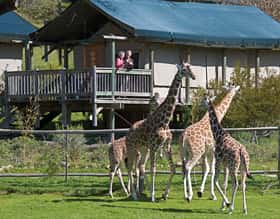
Safari West hosts an occasional curious celebrity, too: soccer legend David Beckham and his wife, Victoria, dropped in a couple years ago. “They wanted the experience of being in a tent, but couldn’t spend the night,” says Caserta. “So they took a tour and rented one of the tents to have lunch on the deck.” Victoria, a familiar face on the haute couture runways of Europe, arrived wearing high heels––not unexpected for the one-time pop star. But, Caserta explains, heels and sandals are strongly discouraged at the private animal sanctuary. “We tell our guests to wear flat, closed-toe shoes and to bring their camera and sense of adventure.”
Sleeping under the stars
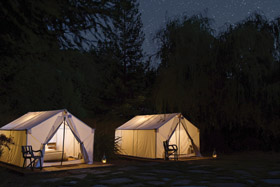
The 10-by-12-foot canvas tents were booked for the entire summer last year, and Newport anticipates this summer will be just as successful. Available from Memorial Day through the end of September (weather permitting), the tents rent for $139 on weekdays and $179 on weekends.
“The tents are furnished with the same mattresses and luxurious linens as in our hotel rooms,” says Newport. Electricity is provided, including a power cord for guests to plug in their own devices, but there are no televisions. A full menu of spa services can be arranged, from facials to couples treatments.
Reserving all three tents among a group of friends has become popular, Newport says. “That way, they have their own gate to the backyard and their own space outside that’s private. There’s a picnic table they can all share, and we can build a bonfire for them. Our tent guests may be sleeping under the stars, but we’ll still deliver a complimentary breakfast to them in the morning.”
The tents have Wi-Fi access and most major carriers supply cell service to the area. Even so, Newport encourages his guests to turn off their phones and laptops. “I understand that some people want or need to be fully connected to the outside world. I get it, but I’m always fighting it.”
The Airstream experience

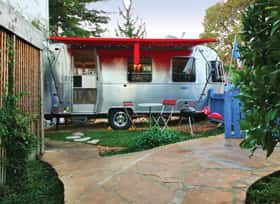
This spring, the hotel’s owner, Marie Saint Clair, replaced the Airstreams that had been onsite with two new, more opulent trailers. The smaller of the two new vehicles, a 22-foot-long Airstream called “Bambi,” rents for $149 per night. The larger trailer, a 28-foot-long, limited-edition Airstream (only 75 were manufactured), is billed as a honeymoon suite; rates range from $195 to $225 depending on the date. Maximum capacity in each is two adults. Saint Clair says financing for the pricey new Airstreams was arranged through SAFE-BIDCO and First Community Bank.
The jazzy trailers feature memory foam beds, large HD televisions, full baths, full kitchens, heating and air conditioning, and complimentary organic coffee and pastries from the hotel’s cafe. “So it’s indeed glamping,” explains Saint Clair, “but with extra amenities, such as maid service.”
Many of the hotel’s guests are there specifically for the trailers. “A lot of people can’t afford to buy an Airstream but still love them. So it’s a chance for them to stay in a deluxe Airstream without spending $100,000 or more,” she says. Guests are also asked to remove their shoes while inside the trailers. “Everyone is really good about that—we get very nice people here.”
The Metro Hotel plays host to many visitors from Europe who read about the Airstreams online and want to try one, “because they don’t have many Airstreams in Europe,” says Saint Clair. She also credits a recent mention of the hotel in Sunset magazine for giving her trailer bookings a significant boost. “Our French-themed hotel is quirky, too. Between it and the trailers, we’ve earned a lot of business.”
Napa County yurts

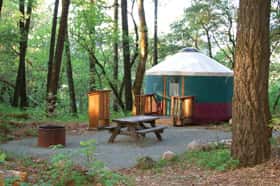
Three round, canvas-sided yurts were first installed at Bothe-Napa Valley State Park in summer 2012, becoming so popular that seven more were added in 2013. The park is situated about halfway between Calistoga and St. Helena along Highway 29.
The three original yurts are 21 feet in diameter and can sleep up to six people. The smaller yurts, 16 feet in diameter, are designed to sleep four. All are minimalist, with a mattress on a platform bed, an additional cot or two, table and bench, and a skylight at the peak. Each yurt campsite has an outdoor fire pit, picnic table and storage locker for food. There’s no electricity in the yurts; toilets and coin-operated showers are nearby.
“The yurts are really a great experience. People should bring along whatever they need or want, just as if they were camping,” says Jay Jesson, an aide at the park. “To say the yurts are ‘luxurious’ might be stretching it, but you don’t have to put up a tent.”
A major advantage of these yurts is having the first-class restaurants of St. Helena and Calistoga only a short drive away in either direction. “We find that many people who might not otherwise try traditional camping will try our yurts,” says Jesson. “And the park is close to everything––we’re not so remote that campers can’t still dine well every night.”
This season, the larger yurts rent for $75 on weekends (two-night minimum) and $60 during the week. The smaller yurts are $70 on weekends and $55 during the week. There’s no restriction on food being stored or eaten in the yurts, but cooking must take place outside.
The park has a 24/7 security presence, including a full-time ranger and resident hosts who live onsite (with at least one dedicated to looking after the yurts). “In addition, the yurts have locking doors, but campers are still strongly encouraged to take their valuables with them when they go out,” says Jeanne Marioni, who handles events and programs for the Napa County Regional Park and Open Space District.
Down by the seaside
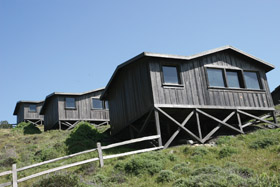
“Because of their location, perched on a cliff near the water, the cabins can seem really remote,” says Rob Walton, the park’s supervising ranger. “But that’s part of the appeal—to get away from it all yet still be close to home for most of our regional visitors.”
Cabins have existed in this spot a mile south of Stinson Beach since approximately 1934, when the land was still privately owned. Over the decades, the marine environment deteriorated the original structures and there have been many rebuilds and repairs since. “The cabins are not officially ‘historic,’ as some people think,” says Walton. “Most of the materials in them are no more than 20 years old and, once per year, we close them for intensive maintenance.”
It’s a short hike from the cabins down to the beach, where up-close encounters with sea creatures often take place. “I recently witnessed a child who was amazed to watch sea lions and porpoises in the wild,” says Walton. “We get a lot of families in the cabins and, for many of those children, it’s their first experience being near the ocean.”
Each cabin (renting for $100 per night) is furnished with a sleeping platform (minus a mattress), a wood-burning stove and a picnic table with benches. Outdoor grills are provided and potable water is nearby. The parking lot for the cabins is a few hundred feet up the hill, so wheelbarrows are available for glampers to roll their provisions with ease from car to cabin. There’s no electricity or running water in the cabins, no Wi-Fi onsite and only limited cell phone service.
Walton says a suggestion several years ago to wire the cabins for electricity was met with stiff opposition. “There was a huge outcry from the public––they didn’t want any upgrades. Our cabin campers are a pretty mellow group.”
Vintage and tiny
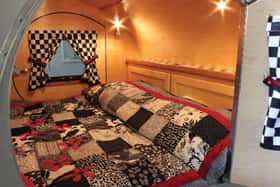
Each trailer has a custom-designed interior and accommodates two adults. “Chili Pepper” is the company’s most popular teardrop, with eye-popping linens and curtains. The “Can ’em Danno” trailer, decorated in a Hawaiian theme, was once featured on the cover of Sunset magazine. The third trailer, “L’il Bear,” has a bear-themed interior.
“The exposure in Sunset really boosted our rentals, because we don’t advertise in any way,” says Kosareff. Depending on the season, rates for the teardrops can range from $130 to $175 for a two-night minimum, and $60 to $80 for each additional night. A 15 percent discount is given year-round if renting for seven or more consecutive nights.
The planned fourth trailer will also have a Hawaiian vibe (with curtains made from fabric the Kosareffs found on the islands) and will be five feet wide to accommodate a queen bed. “When it’s ready, I guarantee it will be the most requested unit,” says Kosareff. The other trailers are either four or four-and-a-half feet wide, which can be a bit tight for some couples.
“I tell people who rent from us for the first time that they’d better like being close, because these teardrops are small,” says Kosareff. “But we’ve had couples well over six feet tall who rent the trailers and just love it. The units are easy to take camping just about anywhere, and many people are renting them for a week or more.” Can ’em Danno, in fact, has been as far east as Chicago, he says, and another teardrop was rented for three weeks by a couple who took it to Colorado to get married.
The back of each trailer opens to reveal a roomy kitchen galley that renters can equip to their liking. The Kosareffs supply some basic needs in the trailers and, for an additional small fee, will provide extra items such as a propane stove, camp chairs, bedding, towels and kitchenware. A vehicle with a trailer hitch is required to pull a teardrop.
“Our rental business is really picking up,” says Kosareff, who also builds and sells custom teardrops. “Each year seems to be a little better than the last.”
Can I Bring My Dog?
Dogs are people, too, right? Actually, no. Without exception, these “glamping” cabins, yurts and trailers are not pet-friendly:
Safari West: The wildlife refuge is very assertive about its no-pet policy, says Aphrodite Caserta, director of communications. “Most of our guests know it’s inappropriate to bring a pet to a wildlife preserve.”
Boon Hotel + Spa: Dogs are not allowed inside the canvas tents. Man’s best friend can be accommodated in a few rooms in the main hotel, but only by prior arrangement.
Metro Hotel: Pets are forbidden in the Airstream trailers. Cooking, however, is welcome, as both trailers feature fully equipped kitchens.
Bothe-Napa Valley State Park: The yurt sites are a dog-free zone (with the exception of verifiable service dogs). Candles are another a no-no. Cooking inside the yurts is also strictly prohibited (that’s what the outdoor grill is for), but food may be stored and consumed inside.
Vacations in a Can: No pets are allowed in the trailers, with no exceptions. Smoking is also a no-no.
Steep Ravine cabins: Pets are forbidden due to the environmental sensitivity of the area, and five is the maximum number of humans allowed per cabin.
Rustic but Desirable
To book one of the canvas yurts at Bothe-Napa Valley State Park or a Steep Ravine cabin at Mt. Tamalpais State Park, you must make reservations through Reserve America, an online reservation processing system for state and federal campgrounds. Sites at most campgrounds in California’s state parks, in fact, can only be reserved online at reserveamerica.com or by calling (800) 444-7275.
In demand most weekends and for special events such as reunions, a yurt can sometimes be available mid-week without prior reservations, even in peak season. Seeking a spontaneous yurt glamping experience? Bring along all the comforts of home you desire (and a good supply of quarters to take a shower). Call the park directly at (707) 942-4575 to see if one is open.
By contrast, the Steep Ravine cabins are reserved months in advance and can sell out on the Reserve America website within minutes––sort of like a Bruce Springsteen concert. You can request an email alert if a cabin opens up due to a cancellation, and keep checking the website for your preferred dates. Shower facilities are not available at Steep Ravine, but potable water and toilets are close by.
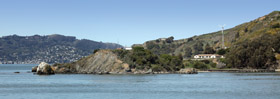

For a truly upscale glamping experience in Marin, Angel Island Conservancy hosts its annual Sleep Like an Angel fund-raiser May 29 through 30. The overnight experience includes island activities during the day, sunset cocktails on the beach, a gourmet dinner, evening entertainment, luxury tent accommodations, wake-up coffee service and a champagne brunch. For more information, go to angelisland.org/glamping2015.
Jean Saylor Doppenberg, CTA, is the author of three books: Food Lovers’ Guide to Sonoma, Food Lovers’ Guide to Napa Valley, and Insiders’ Guide to California’s Wine Country.