It’s more than just dirty dancing.

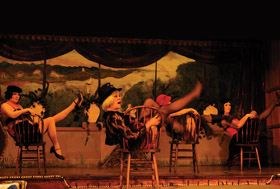
Burlesque as an art form is certainly nothing new. The term first became widespread in 17th century Italy and France, and subsequently England, where it included music, dance and parody. The performance art style became popular in the United States between the 1840s and 1960s, when the term “burlesque” was applied to a wide range of comic plays and musicals. These works, using comedy and music, generally entertained the lower and middle classes in Great Britain and the United States by making fun of the operas, plays and social habits of the upper classes. Whether “burlesquing” a Shakespearean drama or a popular opera, most performances had a comedic social commentary in common, along with a focus on the nude female form. Over time, the element of striptease became more pronounced, along with more elaborate costumes.
Burlesque performances suffered a slow decline after the 1960s, as a result of increasing censorship and dwindling interest, until the 1990s, when burlesque dancing experienced a resurgence of interest on the part of performers and audiences alike. The art form quickly gained momentum, with the first New York Burlesque Festival held in 2002, the Burlesque Hall of Fame opening in Las Vegas in 2005 and the first World Burlesque Games held alongside the Olympics in London in 2012. In 2014, the first industry award, the Brassy Award, was granted, which was created through a joint venture of The Great Burlesque Exposition and Brown Paper Tickets to foster innovation and professionalism in burlesque production. Today, 39 out of 50 states host burlesque festivals and offer regular classes designed for the average woman to develop fitness and body confidence.
A burlesque for everyone
Today’s world of burlesque offers a diverse range of the art form and is growing in different directions every day. Besides the classic styles of burlesque, which are still performed, various subgenres of “neo-burlesque” have evolved, focusing on various social commentary and representing different aspects of today’s culture.

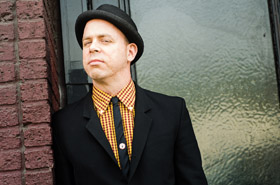
Whereas traditional burlesque is all about the tease and reveal at the end, today’s burlesque, while still usually sensual, is often less about the stripping and often more about the social commentary, political statements or humorous punch line the performance is trying to make.
Dancing in demand
No matter what the style, theme or statement a show is making, the consensus overall is that burlesque as a performance art is growing in demand, which the highly attended shows can attest to. While nobody can say for sure why the burlesque resurgence happened, various theories include event producers simply thinking more creatively and an increased demand for more engaging, edgy shows. One reason burlesque shows often appeal to a range of audiences is the accepting nature of the performance itself, which embraces all body types and genders. In fact, surprisingly, the majority of audiences at burlesque shows tend to be women, and the ages of patrons can range widely.

Berg agrees, but does clarify that it can also depend a lot on what type of show is being featured.
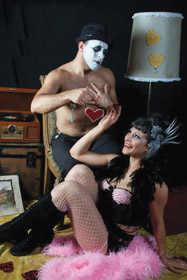
“In my experience, it tends to be predominantly female in the audience,” says Berg. “People don’t expect that. It really runs the gamut; certain genres appeal to certain people. Obviously, boy-lesque appeals more to gay men and women; nerd-lesque is going to draw in a younger crowd, people in their early to mid-20s; classic burlesque can draw in older people who remember it from their youth or those interested in retro-culture. It really does depend on what kind of show it is. Burlesque can run from very tasteful and traditional to super raunchy and challenging.”
North Bay audiences have been especially receptive to burlesque event producers moving in, reflecting a nationwide trend of burlesque shows increasing more in smaller towns than in larger urban centers such as San Francisco, Seattle, New York, New Orleans or Las Vegas—the “big burlesque towns.”
“It’s totally surpassed my expectations,” says Berg. “When I started doing outreach on this, I really thought it would be a limited market and that we would quickly reach a saturation point. But what I’m finding out is that it’s really taking off in smaller areas. It’s growing outside of the traditional centers that we associate with burlesque and is becoming more of a grassroots movement.”
Taking root in the North Bay
Berg credits economics as a big reason for the growing number of burlesque shows outside of bigger cities.
“It’s getting harder and harder in big cities to find affordable venues and come out ahead,” says Berg. “You’re often just breaking even. Now that people are expanding out of the cities, they’re finding audiences they didn’t know existed before and it’s more affordable—so they’re making a little more money.”
Having a vibrant local burlesque scene with a population that prefers to limit their travel helps both the performers, who don’t need to travel as far to shows, and the patrons, who can stay local to attend a unique, fun event. In addition, event producers can capitalize on these distinct local communities by collaborating on shows that bring awareness to the industry as a whole, rather than acting in competition to each other.
“A lot of people around here don’t travel very far for things,” says D’Luscious. “They like to be really local, and there are so many wonderful things in each area. If the shows have enough of their own unique character and they space them out somewhat geographically and on the calendar, there’s plenty of room for all of us. As performers, it’s wonderful that we have more local opportunities. We don’t have to travel all the way into San Francisco or Oakland or other places.”
For venues, the growing popularity of burlesque shows has been economically appealing, as bringing in these shows not only brings people in the door, but obviously boosts bar and food sales as well.
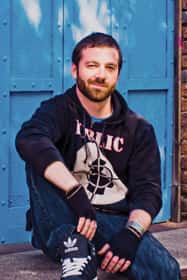
Ward has been invited to produce a burlesque/cabaret event at the Sonoma Mountain Event Center in Rohnert Park, which will take place December 11 and could potentially become a recurring event. “We’ve also been invited to reproduce ‘Sin Peaks,’ our David Lynch-themed show, in Oakland at the Metro Opera House, which is tentatively scheduled for this month,” Ward says. “So while our flagship event is at Whiskey Tip, we’re beginning to gain interest from other venues and markets and are looking to branch out create North Bay Cabaret events all across the Bay Area.”
For Lagunitas Brewing Company, which incorporates burlesque performers into its annual Lagunitas Beer Circus, hosting this type of performance art has been more about supporting these artists and fostering a sense of community.

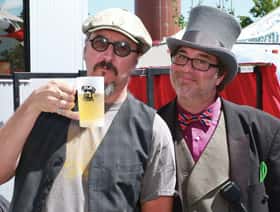
“We’ve always felt connected to the hard-working entertainers who make art for the love of art,” says Jim Jacobs, director of events at Petaluma-based Lagunitas Brewing Company and “ringleader” of the Beer Circus, which benefits Petaluma Music Festival (a nonprofit that provides funding to Petaluma-area schools). “Not many get rich on performing with the countless hours, long tour schedules, dark motel rooms in nameless towns, not to mention the grit and sweat of the performance.
"The Lagunitas Beer Circus is about community. It’s great to be part of a giving, sustaining community of people making things better. Adding some absurdity, some darkness, some wildness gives everyone the ability to let loose and reinvigorate the spirit.”
Dance to live or live to dance
Because of the margins involved in organizing and producing a burlesque show, most professionals involved in either performing or producing (or both) tend to still work “day jobs”—often in related fields such as art, music, dance, modeling, fashion or teaching.
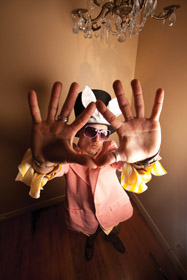
“I’m really a jack-of-a-few-trades,” says Malone. “You kind of have to be that way to make a sustainable living in this industry. It’s really hard to make a decent income off of just being an artist or just being a talent buyer or agent.”
Especially in this type of performance, which isn’t considered mainstream, income primarily comes from ticket sales. Occasionally, there may be sponsors (Cabaret de Caliente is sponsored by iCandy Pole Dancing Studio and Spice Sensuality Boutique) but for the most part, producers rely solely on what the show brings in at the door and, occasionally, a percentage of bar sales.
“It’s mostly ticket sales that we depend on,” says Malone. “There’s a small level of sponsorship but definitely not enough to float all the expenses of these shows. They can be pricey, because you have so many performers. It becomes challenging to make sure the ticket prices are affordable to guests but also high enough that everybody can be paid. That’s the dance.”
From doing to teaching
For some, gaining some income on the side teaching classes has evolved into a business in and of itself. Bonnie Zimmermann, founder of Napa-based Inner Burlesque, has been dancing her entire life and started performing in and producing theatrical shows in Napa about 16 years ago; many of the productions incorporated various aspects of burlesque. About five years ago, Zimmermann decided to teach burlesque classes and workshops in Napa. As she started teaching other women how to dance in this style, there was an immediate interest in the community.
“First of all, it’s great exercise, and it’s very empowering,” says Zimmermann. “So many women are really uptight about their bodies. They feel they’re too fat or too short or too tall—and that’s not the truth. We’re all beautiful. It doesn’t matter what you look like. By embracing your own physicality, it frees your spirit. It gives me great joy to see that happen to women.”
The “Inner Burlesque” classes were immediately a hit, and Zimmermann notes that in the first set of classes, she literally had women ranging from 16 to 80 years old.
“When I tell women I teach burlesque, many say, ‘Oh, I’d love to do that!’,” says Zimmermann. “It seems to be some kind of mysterious thing, but it isn’t. It’s all the elements of dance. The commonality [among my students] is that they all want to learn how to let go—and burlesque doesn’t judge you.”
Will burlesque become mainstream?
Certainly there will always be a segment of the population that will find burlesque unacceptable. However, the exponential growth the industry has experienced over the last several years indicates that demand will continue to increase nationwide, especially with shows becoming more sophisticated and of better quality. Having the “Burlesque” movie, starring Cher and Christina Aguilera, come out in 2010 has also helped bring the performance art to the mainstream.
Locally, the quantity of shows available may have reached their peak for the North Bay market. But, at this point, it’s too early to tell.
“I think it’s at a prevalent point but I’m not sure it’s going to grow much further up here,” says Malone. “But I also don’t think it’s going to die out tomorrow. Right now, it’s in a cozy, viable zone. I think it’s going to be around for a long time—it already has! But it’s sure nice to see the modern, hip renaissance of it.”
The classical, baroque definition of burlesque was a parody on society. So the performance art, by definition, has a sustainable model for survival because it’s constantly changing and evolving. As Berg quips, “As long as there’s a society to make fun of, I think there will be a burlesque performer doing a routine, poking fun at—or adding a naughty spin to—whatever the issue is.”
The Art and Soul of the Striptease

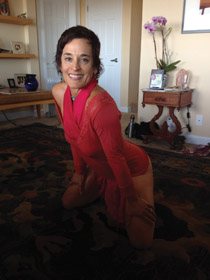
So explains Diane Greenberg, facilitator and teacher of Marin County-based The Sacred Art of the Striptease, when asked her reason for starting erotic dancing and striptease courses about 17 years ago. After working for years as a professional performer and adult entertainer, Greenberg experienced how much personal power and liberation was available from the unanimous attention she could gather as a dancer on the stage. It’s in her three-hour classes that she works to bring out the abundant beauty and sensuality that, she says, is in all of us.
“I believe there’s an innate wisdom that’s within each one of us,” says Greenberg. “My mission for this work is to awaken that wisdom. So every one of us that knows that ‘I’ am more beautiful, more sensual and, perhaps, more sexy than I ever thought I was.”
While some of her students use her classes to launch or further their careers in dance, burlesque and other performance arts, many of them participate simply for their own (and their partner’s) enjoyment—and, perhaps more important, to help themselves gain a more self-confident attitude that translates into all areas of their lives.
“The student is any person asking to bridge where they are now with their future; an awakening into more self-expression and personal integrity,” says Greenberg. “I believe my class opens us up to a deeper connection with our greater self-expression and experience. Not only will this show up in your bedroom, but also in your boardroom and in relationships with family and friends. It’s an awakening and celebration of your own self-confidence.”
Most students come to Greenberg through referrals or have specifically sought out her services. She does vey little marketing of her services outside of using her website, www.sacredstriptease.com, and relying heavily on word of mouth.
“I find that if people are looking for me, they’ll find me,” says Greenberg. “And those who know about me will probably share because their experience is usually very profound.”
Bachelorette parties, bridal showers, and “girls’ night out” parties comprise another significant segment of her customers.
After several years of teaching classes and multiple requests from her students and acquaintances, Greenberg decided in 2007 to produce an instructional video, The Sacred Art of the Striptease:Awakening the Divine Feminine, to teach women in an informative and transformational way how to striptease. More than the average “how-to” video, it’s more about stripping away the self conscious, judgmental, limiting and even self-loathing inner dialogs that many women have been carrying since childhood. Sales of the video have remained steady over the last eight years, selling all over the world primarily through her website and in specialty adult boutique stores such as Pleasures of the Heart in San Rafael.