The Education 2 Career Construction Skills program is a partnership between College of Marin, the Marin Builders Association and Canal Alliance. [Image by Paige Green]
A glass of fine wine, a celebratory dinner at a restaurant and a brand-new house have something in common—chances are, immigrants are somewhere in the picture.
And yet, immigration is an outlier in most discussions about the economy.
Production, businesses, consumers and investment get attention—but immigration is often overlooked, even though it plays a major role in keeping the economy strong.
While immigrants come to the United States seeking to improve their lives, once here, they can relieve workforce shortages, start new businesses, drive innovation, pay taxes and spend money, thus supporting the economy in a host of meaningful ways.
San Rafael economist Jon Haveman has explored immigration’s place in the economy in depth and evaluates related policy issues. A principal at Marin Economic Consulting, which provides reports on economic performance to government agencies and economic development organizations, Haveman has served as chief economist on the President’s Council of Economic Advisers, was chief economist for the Bay Area Council Economic Institute and has been a member of the board of the National Economic Education Delegation (NEED) for nine years. The purpose of NEED is to provide accurate economic information and give people a better understanding of how policy decisions affect the economy—enabling voters to evaluate claims about the economy and understand what the implications of proposed policies would be, should they go into effect.
“It would be better if the electorate had a better understanding of the issues. Most of the narrative … from an economic perspective, is just plain wrong,” says Haveman.
“We have a dearth of workers in the United States,” he explains, and immigrants help to keep the economy growing by working jobs that are unappealing to people born here and would otherwise remain vacant. Immigrants filled two-thirds of the new jobs created after the COVID-19 pandemic, and Haveman predicts that by 2042 the need for immigrants will be even greater—because the population of American-born workers will slow dramatically due to lowering birthrates and baby boomers aging out of the workforce.
“That will slow the extent to which we can grow goods and services,” he says. Without immigrant labor, he believes that building housing would be more expensive, the hospitality industry would be shorthanded, and agriculture would lack workers in fields and vineyards.
A growing need
Not all people who come here to work plan to stay permanently. Karissa Kruse, CEO and president of Sonoma County Winegrowers, reports that 6,300 full-time employees are working in vineyards in Sonoma County, and 1,800 are part of the H-2A guest worker program. “It’s been an evolution over the past 15 years,” she says, as farms and ranches have moved toward a greater full-time workforce and fewer part-time workers. “The notion of a seasonal workforce has gone away,” she says. In addition, increasing competition from other fields such as construction and the cannabis industry is making it more difficult to find employees, who fill a variety of roles, such as pruning, harvesting, vegetation management and wildfire mitigation. To fill full-time positions, owners have increasingly come to rely on workers with H-2A visas, who have 10-month contracts and plan to return to their home countries when those contracts end. The government considers their employment full-time, and “What people don’t know is that it’s a federal program that’s highly regulated,” she says. Employers must pay workers a mandated minimum wage of $19.97 an hour and provide transportation and free housing, which is subject to inspection and requires approval. In addition, they must advertise jobs in four states and show that that they can’t get takers, thereby demonstrating that bringing workers from outside the United States is a necessity.
Steve Dutton of Dutton Ranch in Sebastopol, to whom Kruse is married, has been bringing in guest workers for several years, and this was one of the most successful years yet. “You’re always anxious when you have to bring people here from Mexico, but the process was really smooth this year,” she says.
“Sonoma County, given our topography, it would be a long time, if ever, that we could be a mechanized industry,” says Kruse, pointing out that grapes are labor-intensive, and so a strong workforce is crucial for local agriculture—which has a variety of crops, including apples, plums and peaches as well as grapes. The wine industry is predominant, however, and she conducted a survey a decade ago, with results showing wine grapes as a $13 billion business. “That would be a little hard to replace,” she says. “It’s essential that our vineyards survive and thrive.” She adds that properties zoned for agriculture accounted for 26% of Sonoma County’s properties in 2022, and their owners paid $77 million in property taxes. “That’s a vested interest,” she says, pointing out that agriculture is a major part of the local economy, and to maintain it, workers who come from other countries are essential. “Men come, have free housing and earn money to spend back home. They support the local economy in Mexico and fill the labor shortage here. It keeps both economies headed in the right direction,” she says.
Building a workforce
To alleviate the shortage of construction workers locally, a partnership of the College of Marin, the Marin Builders Association and Canal Alliance, a San Rafael nonprofit that helps immigrants overcome barriers to success, offers an Education 2 Career Construction Skills program to individuals authorized to work in the United States. The purpose is two-fold: to provide qualified workers for the construction industry and give immigrants pathways to sustainable careers. Air Gallegos, director of economic mobility at Canal Alliance, explains that the College of Marin was offering training in construction skills but was having difficulty filling classes several years ago. Meanwhile, Canal Alliance had people who were interested but didn’t have the resources to enroll in the program. COM worked with Canal Alliance to remove the obstacles, allowing students to enter the program without a high school diploma or GED, and the revamped program began in 2018.

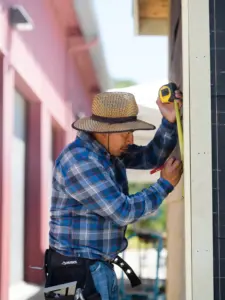
The program lasts six weeks and runs four times a year, and students earn college credits. They have evening lectures on construction skills from 7 to 10 p.m., at Canal Alliance during the week, as well as financial literacy workshops and training to prepare them to create resumes, apply for jobs and go on interviews. On Saturdays, the students work together at COM’s Indian Valley campus to build a small storage unit, focusing on basic construction skills, such as framing, roofing and painting. When they’ve successfully completed the program, Canal Alliance sends their resumes to the Marin Builders Association to share with their partners in the construction industry. Qualified individuals get good jobs that help the construction industry thrive, and they earn sustainable incomes that allow them to contribute to the economy as taxpayers and consumers.
Fabiola Cedeno, workforce target supervisor with Canal Alliance, reports that 323 students have earned certification, and the placement rate is 76%. “We keep following up and giving them support,” she says, with contact lasting up to two years.
“Once placed, they usually stay in a job,” says Gallegos, so employers don’t have retention issues, and they save money by not having to train new workers. “These folks go into the working world, and they’re helping our economy,” she says. “They’re building homes in Marin, and that helps our entire county.”
Succeeding generations
Haveman says that while low-skilled immigrants play an important role in today’s economy, they are more likely to have a greater effect on those who come later. “The path from Mexico to native-born high-school graduate is a long one,” he says, and over time it’s more likely to have a positive impact than a negative one. Traditionally, immigrants have come to the United States to improve their economic status and give their children better educational opportunities, which allows them to achieve more. He reports that while 21% of children of native-born Americans reach the middle class, 35% of immigrants’ children attain that level.
Kirkman Lok, CEO of the Lok Group of Companies in Santa Rosa and treasurer of the Sonoma County Hospitality Association, is a second-generation American on his mother’s side and fifth generation on his father’s. His mother came from Hong Kong, and his father lived in Chinatown in San Francisco, and he has a first-hand perspective on how each generation changes. “The second generation becomes more American and more educated. Third generation Americans are so integrated that they’re almost invisible,” he says.
He observes that when immigrants first arrive from other countries, they face significant challenges and often have to deal with a language barrier and discrimination. However, they work hard, make sacrifices and raise families, aspiring to give their children better lives. The average American wouldn’t receive enough pay to take certain jobs, but immigrants are willing to fill those positions. Meanwhile, education becomes an opportunity for the next generation and gives their children more career choices. They tend to enter fields that are white-collar or science and technology. “Or they might get into small business like I did. We bring a different skill set to a family business,” he says, and each generation does better and expands the scope and the business model.
His story begins with his father. “My dad came out of the navy after World War II, and his first business was a wash-and-fold laundry in the Mission district,” he says. He did well enough to eventually buy apartments and wanted a business that would include the whole family. His first motel was in Santa Rosa on Mendocino Avenue. “He bought it from a couple in the 1970s, and that’s how we started the business,” Lok says, adding that the city eventually purchased it and converted it into a homeless shelter. He decided to join the family business after graduating from the University of California, Davis, and his family bought a motel in Stockton for him to manage. Today, he owns the Fairfield Inn in Sebastopol and the Quality Inn in Petaluma, as well as being CEO of the Lok Group of Companies, which has been owning, managing and developing hotels since 1985.
As a business owner, Lok is also an employer. “The majority of my employees are immigrants,” he says, explaining that the language barrier often prevents them from pursuing other opportunities.
He treats his employees well and has low turnover. “They’re great employees,” he says. One who was a nurse in Mexico has been in his employ for 25 years, and another was an attorney. He finds that immigrants are often supporting families in their native countries as well as themselves on the wages they earn. “That happened with my parents, too,” he says, explaining that it’s a common thread.
Immigrants still have close ties to their country of origin, and some of the wealth they create often goes to help relatives there. “The important thing is that they’re part of economic vitality. They’ll take on jobs that the average American won’t,” he says, giving roofing as an example. “Without them, construction would come to a standstill.” Others work in kitchens, and many restaurants would have insufficient staff and be forced to close without them. “In my industry, especially in California, we would not be able to stay open without an immigrant labor force,” he says. “Immigrants come from all over the world,” he adds, reporting that he has friends who own hotels in areas with national parks, and they must hire immigrants from places such as Europe and the Caribbean for the season on H-2A visas.
“Without them, places wouldn’t be able to open,” he says. “This country was built on the backs of immigrants. They’re one of the reasons why we’re innovative and competitive.”
Give and take
The most-expressed belief is that immigrants take away from native-born Americans. However, says Haveman, “Research shows that’s just not right. Immigrants don’t just work when they’re here. They live.” They pay for housing, shop to meet their daily needs and buy cars. They also help unskilled Americans. He gives the example of an individual who starts a lawn-mowing business and does all the work on his own, because it’s too expensive to hire help. Immigrants, though, will work at a relatively low wage, so he can hire someone to mow the lawns and repair equipment, thus allowing him to be client-faced and grow his business. “It’s a step up the economic ladder,” says Haveman. Immigrants provide services such as childcare and housekeeping for professional women, such as doctors and lawyers, as well, allowing them to provide services to the community. Thus, immigrants make opportunities for advancement possible for people born here.


Educating immigrants’ children tends to pay off in the long term with the second generation making greater contributions to the economy. Recipients of the Deferred Action for Childhood Arrivals program are 26 years old on average and part of generational change as they work their way up the economic ladder. Haveman believes that attempts to deport them are foolish. “From an economic perspective, it’s ludicrous. We’ve paid to educate them. We, as a society, have made big investments in them,” he says, and deporting them would prevent that investment from paying off. He adds that DACA individuals might have been 5 when they arrived in the United States and don’t know any other home, and 1.3 million American citizens and legal residents live with them. “We’d be ripping apart a lot of families,” he says, as well as taking a reasonably well-educated part of the economy out of production.
Haveman believes that immigration has little downside. “Most of it is upside. A good thing would be to increase the number of people we let in in an authorized way,” he says, because that would allow them to participate more fully in the economy, which would be better for them and us. “They contribute everywhere in the economy,” he says.