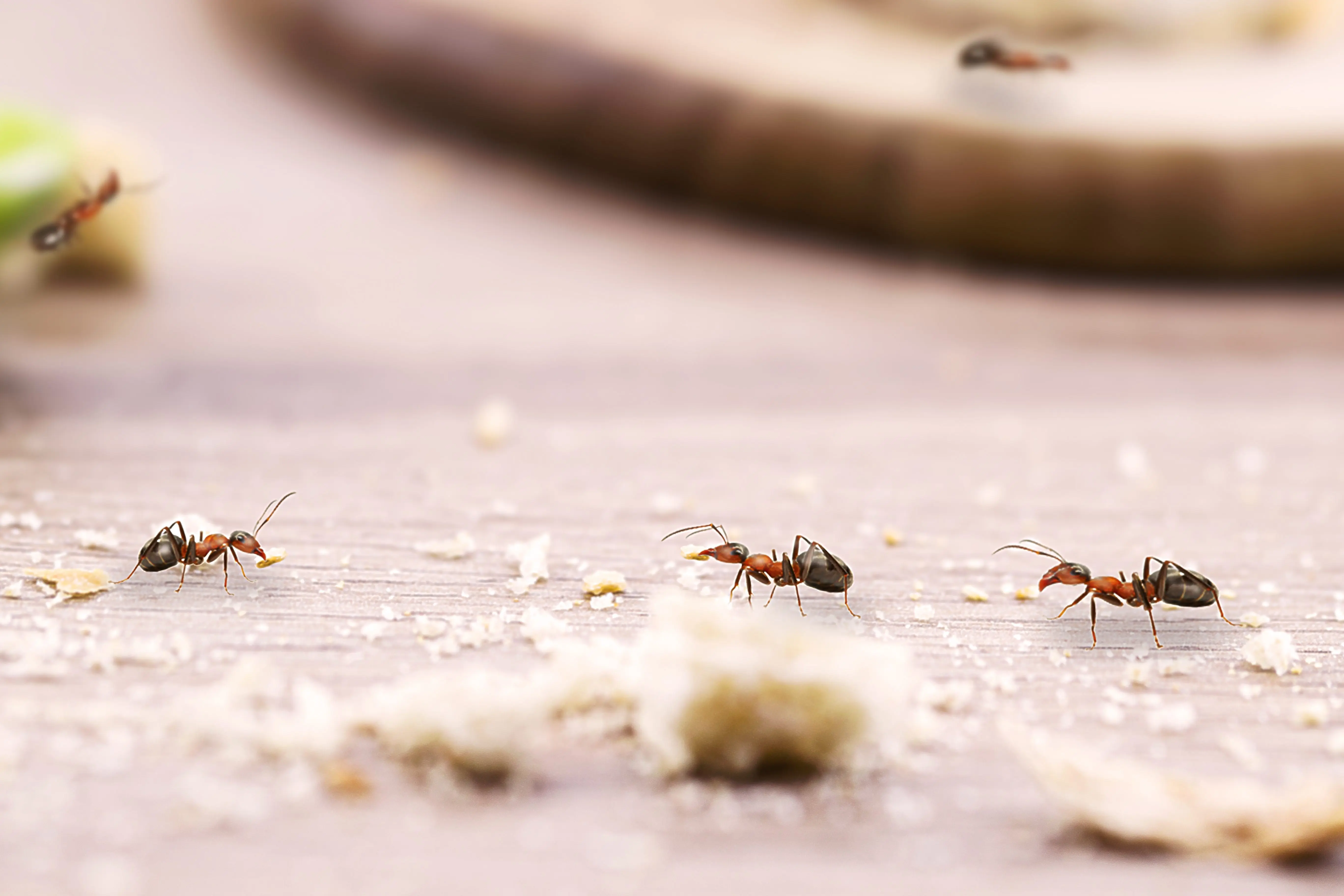
“When all the little ants are marching, red and black antennae waving—they all do it the same way.”—Dave Matthews Band
Boy, you’re telling us.
The recent rains filled our reservoirs, watered our gardens and, less helpfully, riddled our kitchen and living spaces with ants. After one downpour they seemed everywhere. And we mean everywhere. At home lines of ants were in the kitchen, a pair of bedrooms and a bathroom. At work, the office breakroom had them in the sink and, somehow, they ended up in the freezer.
Ants are a common problem in wet weather—the water displaces them underground and they come seeking safer, higher, dryer ground. They’re not the bad guys—just trying to get by like the rest of us. Still, they’re always on the scout out for food—and they’ll swarm the sweetest crumb. At the very least, it’s a nuisance. At worst, species like carpenter ants (common in the North Bay) can cause wood damage, while the seemingly more benign types of ants will contaminate food and can spread bacteria along countertops. They gotta go.
Of course, one common (and effective) option for ridding a room of ants are the various ant-killing sprays available at the local store. We can’t deny these do the trick. That said, fast-acting sprays often employ pyrethroids—a chemical that is especially troubling for cats (their systems can’t break it down) and even some dogs if they were to accidentally consume too much of it. On top of that, our 14-year-old, protector-of-all-living-creatures daughter pleads with us not to break out the Raid. And, lest we be viewed in her eyes as the perpetrators behind Antageddon, we tend to go a natural route when possible. Here are a few common options:
- Citrus: A healthy squeeze of lemon or lime (the stronger, less-sweet citrus the better) near entry points is a major diversion—they hate the acidity.
- Cinnamon and other spices: Cinnamon and cayenne pepper are the most recommended. Cinnamon contains cinnamaldehyde—and ants dislike the scent. Pepper, meanwhile, is an irritant to their sensory systems. Full disclosure: We’ve tried applying both cinnamon and various peppers in little barrier-mounds to discourage ants, with little success. They just march past, laughing. Perhaps it irritates them, but not enough to abandon their quest for the splattering of syrup someone spilled near the stove. Apparently, the store-bought cinnamon in most homes doesn’t have cinnamaldehyde in high enough concentration to be effective.
- White vinegar mix: Equal parts water and white vinegar in a spray bottle can be applied to surfaces where the vinegar disrupts their pheromone trails (that’s how they navigate and communicate so effectively in that line!) This is a short-term fix, as once the vinegar cocktail dries, its effectiveness is gone.
These natural ant remedies should best be viewed as ant discouragements—preferably used at entry points. As to the entry points themselves, sealing them off is the perfect preventative measure. Unfortunately, in most older homes (such as ours), there can be a lot of invisible entry points that aren’t known until that colony has been there long enough to warrant chipping in on the mortgage. So, is there an effective natural way to remove the ant trail itself? There sure is: It’s called broom, dustpan and cardboard box.
The ants make this somewhat easy, being in a clearly visible black line and all. We take a broom (or dust broom on counters), quickly sweep them up into the pan and shake them into a medium-sized cardboard box. A quick attack is imperative, as they’ll scatter amid the chaos, and those in the box will head for the hills trying to get out. But you can round up a sizeable ant trail in a matter of about 30 seconds. Then—hurriedly, before the critters escape—we put the box outside away from the house; within a few minutes, the ants are off to other adventures. Word of caution: Those new adventures might involve a return to your house—especially if you’ve got a particularly determined nest/colony in your ‘hood. If ants prove a persistent problem, our local hardware store recommends ant bait (aka ant traps) placed at high-ant-traffic areas. (Like the spray, keep these away from your pets!) The baits include a protein-rich food, mixed with a slow-acting poison which, when brought back to the colony by scout ants, can eliminate the whole lot. We’ll consider this Plan B if the little buggers refuse to take a hint. Just don’t tell our daughter.