



Economic forecasts are often lumped together with weather forecasts because both draw criticism when they are wrong. While such an analogy sparks many a bad, overeducated dad joke about economics, a key similarity to weather forecasts lies in the choice of forecast horizon. Weather forecasts have long-term versions (think Farmer’s Almanac for a classic source), but are less reliable the longer the horizon. Economics suffers a similar fate, the longer the horizon; economics is built on markets and systems with incentives and patterns that can be seen over a bit longer than the 10-day on your phone. However, after more than two to three years, economic forecasting gets very tricky, with a central estimate surrounded by an increasingly wide margin of error.
Demographic forecasts tend to be more accurate over longer-term horizons because the ways populations change naturally and people move from place to place tend to be longer-term characteristics of humans than how someone invests, how people work, or how businesses, households, and governments spend. When immigration policies change, that is a key wrinkle in forecasting change, but populations tend to shift their fundamental characteristics slowly.
The California Department of Transportation (Caltrans) has been providing socioeconomic forecasts in parallel with the California Department of Finance (DOF) for some time; see this website for current and historical forecasts. To show the time horizons, let’s consider the current employment forecasts for Sonoma, Marin, and Napa counties for 2026 to 2040 (based on 2024 annual data, the latest known data at the time of these forecasts), along with the population forecasts.
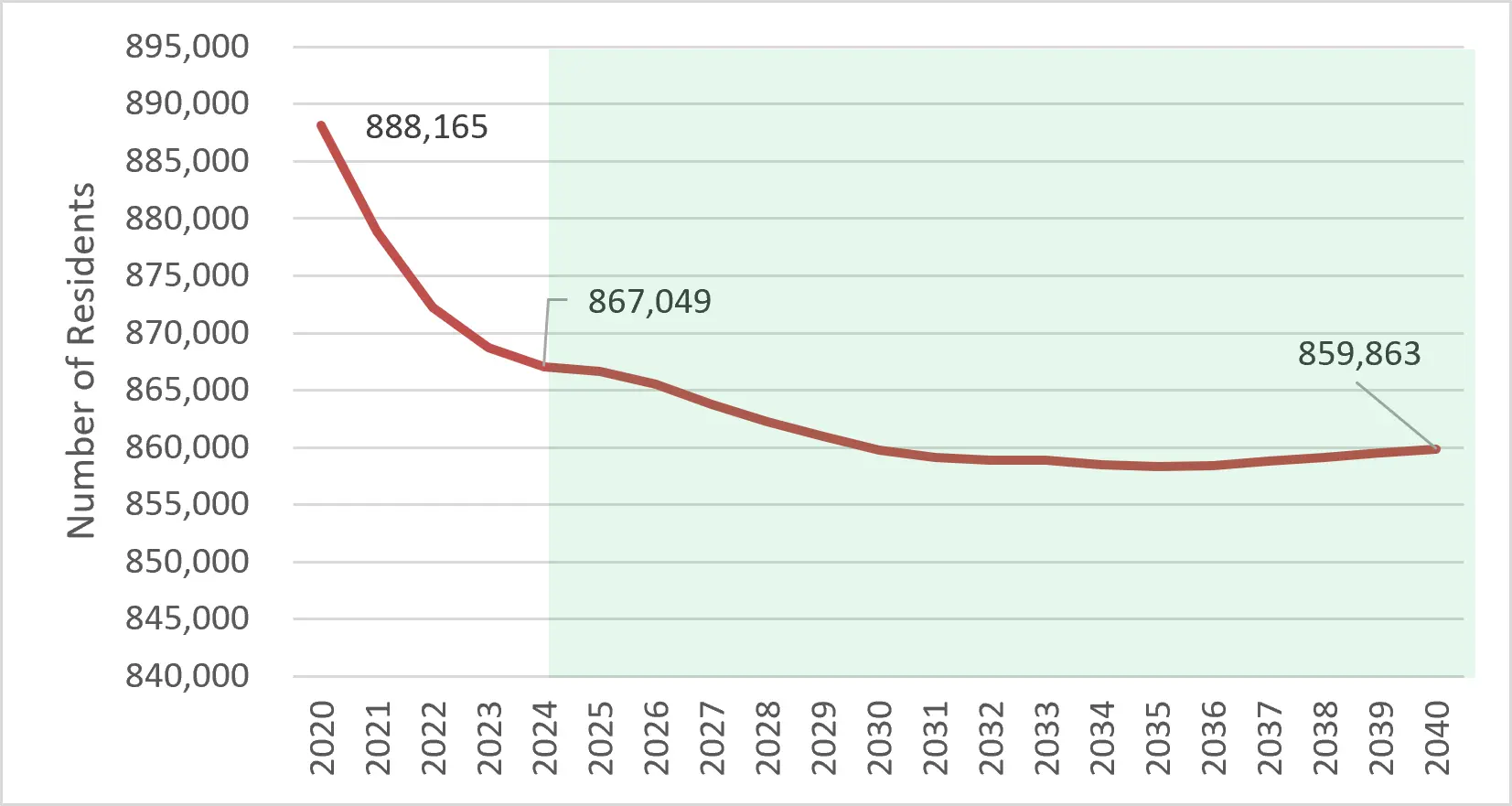
Number of Regional Residents, Forecast to 2040, 2020 to 2040
Sonoma, Napa, Marin Counties Combined (Shaded Area = Forecast Window in 2026)
Source: Long-Term Socioeconomic Forecast, CalTrans and DOF
Notice that the population forecast does not follow a smooth path to 2040. The bumps and lumps suggest expected regional changes, including more children and shifts in migration patterns. The larger takeaway is that population forecasts can capture long-term changes in the distance and in its nuances. The next figure shows an employment forecast that becomes nearly linear after about 2028. Employment can change more quickly than population, making long-term trajectory harder to predict. That smoother trajectory reflects the greater uncertainty involved in projecting employment over the long term. From industry change to artificial intelligence to housing to population dynamics to immigration change, predicting employment levels through 2040 is more difficult and more error-prone.
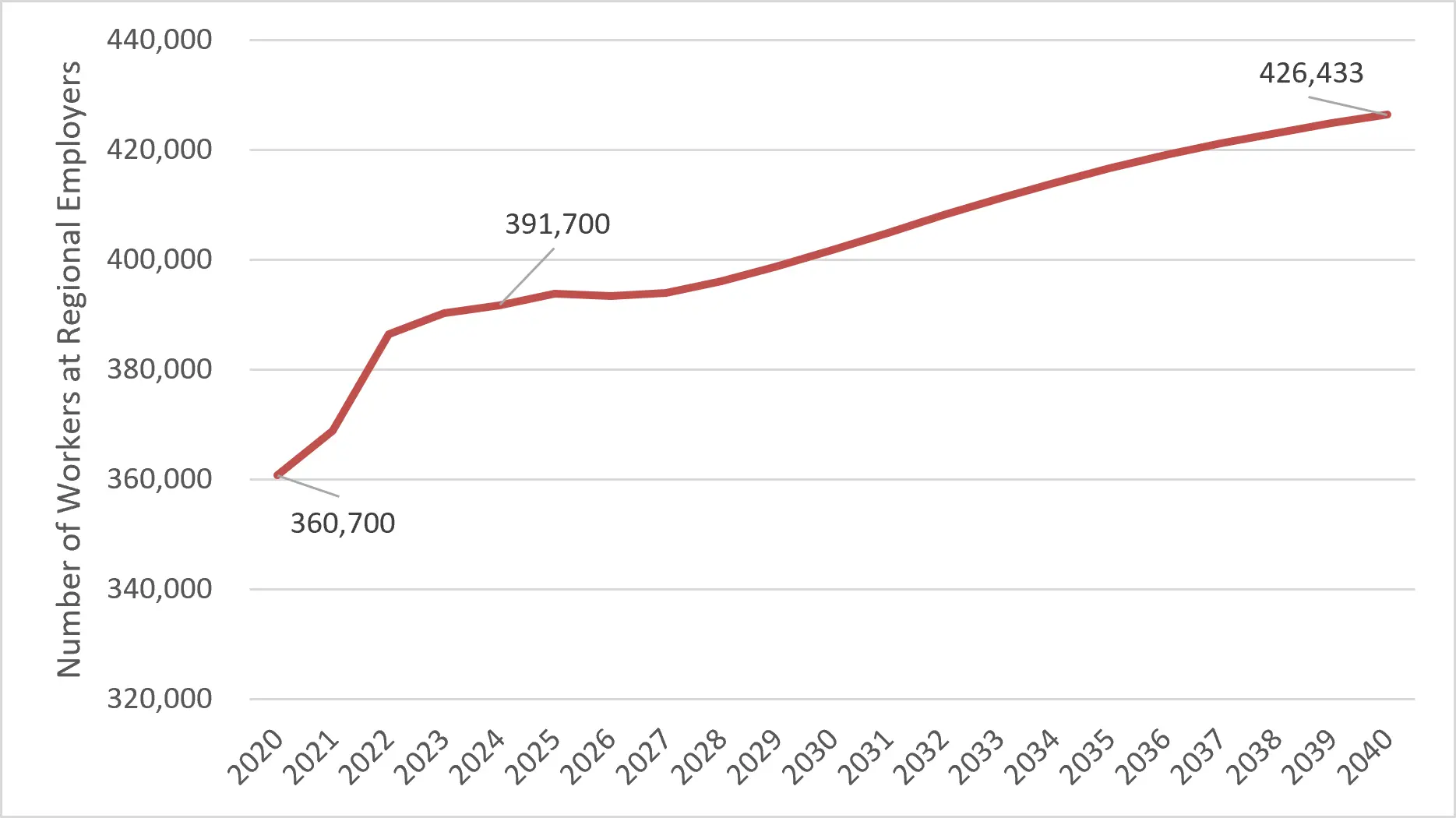
Number of Workers at Local Employers, Forecast to 2040, 2020 to 2040
Sonoma, Napa, Marin Counties Combined (Shaded Area = Forecast Window in 2026)
Source: Long-Term Socioeconomic Forecast, CalTrans and DOF