


Sonoma County’s Harmony Festival celebrated its 32nd year this past June, with an estimated 35,000 attendees. And when it first began as the Health and Harmony Festival in 1978 (the name changed in 2005), the core message was the same: to promote awareness in practical lifestyle changes that would improve our quality of life and make a positive difference on the planet. And what better way to do that than blending music, people and ideas? Some of the notions it started out with were deemed radical at the time: photovoltaic technology, organic food, electric vehicles and the like. Today, those same things are (thankfully) considered much more mainstream, at least in the North Bay.
The festival has always looked toward being green, and today composts all food scraps (everything is sorted through, even the bins marked “recycling,” “compost” or “landfill”). Attendees are encouraged to carpool or use public transport and to bring their own reusable dishware, utensils, cloth napkins and drinking containers. The festival also moved its corporate office to LEED-gold certified Sonoma Mountain Village in Rohnert Park and partnered with Harmonic Humanity, a Marin-based nonprofit advocacy group for the homeless, to raise money and awareness for the organization.
NorthBay biz visited the festival’s Eco Village this year and asked some of the vendors to share their “green tips.” So here’s a little know-how from your friendly festival participants. And if you missed it this year, then mark your calendar for next June—you’ll have fun and learn something, too! That’s why CEO Howard “Bo” Sapper calls it “a party with a purpose.”
Ruth Paradise, Regenerative Design Institute
Get to know your neighbors. This can be a great step toward helping create a more sustainable community. Find out what they need and let them know what you have. You never know when their excess resource could be exactly what you need (or vice versa). As a business, you might find you can band together in ordering supplies, reducing shipping costs and sharing materials. Our neighbors and community can be one of the best resources we have. So go have fun—host a block party, bring everyone together and find out how you can all help each other. Before you know it, you’ll be reducing your carbon footprint and will have a whole host of new friends and colleagues.
Reduce and reuse resources at your home, office or farm. One way to do this is what permaculturists call “stacking functions,” which means to find resources that have more than one use, and then use them for more than one thing. In a home setting, for example, you might have an unsightly fence and too much sun in your backyard to really enjoy the space in the summer. A conventional approach would be to replace the fence and buy a canopy. A “stacking functions” approach would be to plant a grapevine that would cover the fence and climb over a simple trellis to create more shade. This reduces the amount of resources needed to achieve your goals, and it provides a source of fresh fruit as an additional bonus.
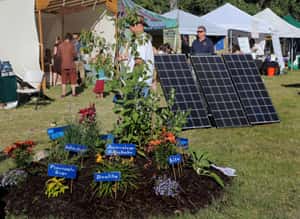
Above: Part of the Regenerative Design Institute’s garden, located in the Harmony Festival Eco Village (Duncan Garrett Photography)
Erin Axelrod, Daily Acts Organization
Don’t buy more than you know you can eat at the supermarket. And make sure you donate any extra foods from events to food pantries. Consider how much energy it takes to make the food we eat, and then take into account that Americans waste approximately 1,400 calories of food—per person, per day. That’s around two-thirds of a day’s supply of recommended food calories or 96 billion pounds of food per year, according to the EPA. Support food gleaning programs in Sonoma County like Petaluma Bounty’s bounty hunters and Healdsburg’s Farm to Pantry. And by all means, put the heat on restaurants, supermarkets and food producers to donate their extra food as well.
Move your account to a local credit union or bank. If just 10 percent of Sonoma County deposits were shifted to local financial institutions, it could create up to $4.8 billion in new local lending.
Graywater systems. The simplest one starts by putting a bucket underneath your shower or bath faucet while waiting for the water to get hot, then use that water to flush the toilet. Consider that the average American’s five-minute shower uses more water than a typical slum-dweller in a developing country uses in an entire day—and nearly 1 billion people in the world don’t have access to fresh water at all. Install a more advanced graywater system for approximately $200 and irrigate your landscape with the used water from your washing machine. Treasure each drop of water: Conserve first, then look for ways to recycle water onsite.
Reuse materials when you build, rather than buying new. Visit Habitat for Humanity’s “ReStore” shop in Santa Rosa, which sells recycled building materials. Try Storm Sash windows for insulation and to save on energy costs. Save hundreds of dollars by avoiding double-paned windows and salvage 100-year-old windows, contribute less to landfill, and more to your pocketbook. Google “Jim Wilkinson Storm Sash YouTube” for a local explanation about Storm Sash windows.
Build a compost pile. Compost your food scraps and yard waste at your house. Adding biomass to landfills creates methane, a Greenhouse gas that’s more than 20 times more powerful than CO2. The amount of food waste generated in the United States is huge. It’s the third largest waste stream after paper and yard waste. In 2008, about 12.7 percent of the total municipal solid waste (MSW) generated in America was food scraps. Landfills are the largest human-related source of methane in the United States, accounting for 34 percent of all methane emissions. And the use of recycled food waste (compost) has myriad environmental benefits such as improving soil health and structure, increasing drought resistance, as well as reducing—and even eliminating—the need for supplemental water, fertilizers and pesticides. Think of it as feeding the soil. You’ll also save the energy it takes to transport your waste and ship it out of Sonoma County, since we no longer have landfills in this region.
No ice, baby. One pint of ice is produced daily for each American, and 50 percent of that is wasted. Yes, that ice you don’t drink translates to wasted water—and wasted energy. In fact, 37.5 million gallons of fresh water are used per day in the United States in ice production.
Brad Lancaster, AP Rainwater Harvesting & Graywater Gardens
Reducing human consumption of groundwater is the key to shifting toward a more sustainable balance with water resources. Water is conserved through rainwater harvesting, graywater reuse, low-flow appliances and the installation of integrated sustainable systems that maximize supply and reduce demand.
Harvesting graywater is a great way to use an onsite, nonpotable source of supplemental irrigation water, which, along with rainwater, can greatly reduce or eliminate our need to irrigate our landscapes with costly potable drinking water, which is the kind of water coming out of most outdoor faucets. However, some of the ingredients, such as salts, that are found in various soaps and detergents can be detrimental to your soils and plants, especially in areas with alkaline soils. Therefore, it’s important to select detergents and other cleaning products that have fewer to no ingredients harmful to plants, and to select appropriate vegetation for the areas of your landscape harvesting graywater.
Ty Bell, HealthForce Nutritionals
Stop buying plastic. Plastic is notoriously bad for the environment and also for our health. Many of us don’t realize that plastics leach toxins into our food products, as well as xenoestrogens, contributing to hormonal imbalance. Plastic is also porous, which allows for oxidation and product degradation. Here are some things you can do: Buy supplements packaged in glass. Buy grains/seeds/legumes in bulk at your nearby health food store, where you can pack them in cellulose bags, rather than reaching for the easy packaged option on the shelf. Switch to glass or stainless steel water bottles. Stop buying bottled water altogether, and get your own house filter. Your body—and the Earth—will thank you.
Michael Gerlach, Sustainable Living Roadshow
Reconnect with your food. Personal and community gardens provide a local source for the food we need while reconnecting citizens with the natural world. Additional produce, dairy, grains and more can be purchased from local farms at farmers’ markets and through participation in CSAs.
Support the arts. Individual and group creativity gives life to any community. Attend performances, go to galleries—create something of your own!
Julie Fadda is editor of NorthBay biz. You can reach her at jfadda@northbaybiz.com.